Economy & Business · The Record
85 percent of surveyed Americans think brands raise prices unnecessarily; USDA outlook predicts food-at-home up 2.7 percent
A vendor-published survey says shoppers blame brands. A fact-check says the president's falling-prices claim is wrong. The federal forecast, the producer-price pipeline and one food maker's margins fit neither account.
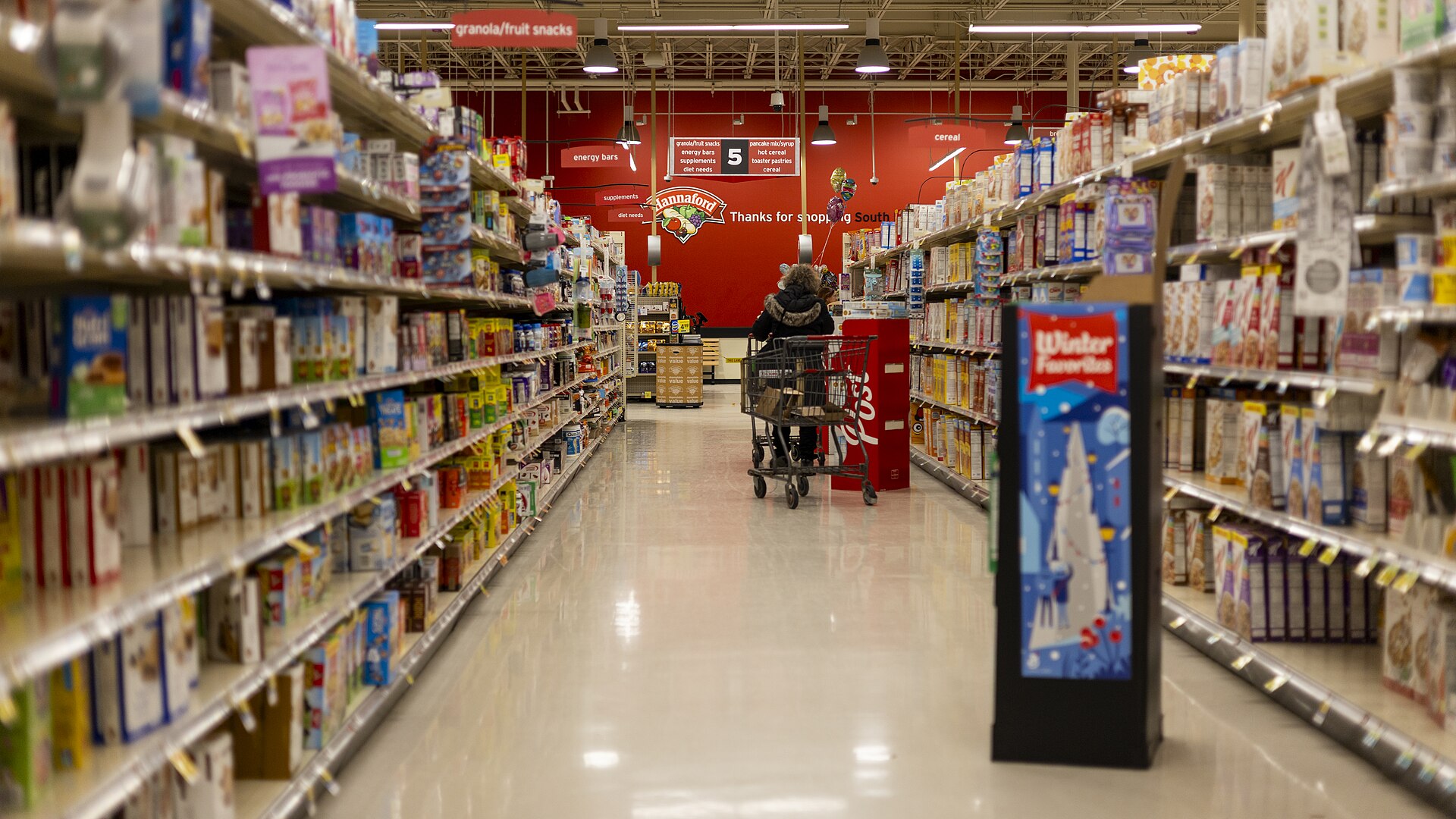
Eighty-five percent of surveyed Americans think brands use inflation as a justification to raise prices unnecessarily, according to a report published on the marketing company Omnisend's own blog. Supermarket News, covering the report, wrote that shoppers believe "brands and retailers often use inflation as an excuse to raise prices more than necessary." That is a finding about what shoppers think of corporate motive. The checkable record on food prices - a federal forecast, a fact-checker's reading of the consumer price index, a producer-price brief and one food maker's own margin lines - tests both that belief and the opposite claim being made from the White House, and it confirms neither.
The survey figure comes from vendor-published research rather than an independent poll: it appears on Omnisend's site, and the excerpt of that report held for this piece carries no sample size, field dates or margin of error. Omnisend's own gloss on the result is narrower than the headline number suggests. "Consumers understand that costs change, but they want those changes to make sense," the report stated.
PolitiFact examined the claim running the other way. In a fact-check dated Aug. 10, 2026 in its URL, PolitiFact reported that President Donald Trump (R) said in a Fox News interview that prices were "all coming down now. The food, the groceries, it's all coming down." PolitiFact's reading of the price data found the opposite direction: overall prices up about 4.3 percent since Trump began his second term in January 2025, and grocery prices up 3.4 percent over the same span. On energy, PolitiFact reported gasoline up 34 percent, fuel oil up 24 percent, natural gas up 12 percent and electricity up 8 percent since January 2025. It also found a handful of grocery items cheaper than in January 2025, naming bread, bacon and eggs.
The federal forecast is the Food Price Outlook, published by the U.S. Department of Agriculture's Economic Research Service. The outlook updated 7/24/2026 predicts all-food prices to increase 3.1 percent, food-at-home prices to increase 2.7 percent and food-away-from-home prices to increase 3.5 percent. These are forecasts, not results, and ERS says so in its own terms: it describes a 95-percent prediction interval as one in which, based on past data, the annual level of inflation is expected to fall 19 out of 20 times.
View the data
| Value (%) | |
|---|---|
| All food | 3.1% |
| Food at home | 2.7% |
| Food away from home | 3.5% |
| Beef and veal (2026) | 10.7% |
| Eggs (2026) | -30.7% |
Source: USDA Economic Research Service, Food Price Outlook - Summary Findings, updated 7/24/2026 · Daily Pol graphic
Two categories carry printed intervals in the record held here, and they run in opposite directions. ERS predicts beef and veal prices to increase 10.7 percent in 2026, with a prediction interval of 7.2 to 14.6 percent. It predicts egg prices to decrease 30.7 percent in 2026, with a prediction interval of -36.5 to -23.4 percent. Eggs are also one of the three items PolitiFact named as cheaper than in January 2025. The single grocery line that makes a falling-prices account sound right is the one ERS expects to fall by roughly a third, against a beef forecast in double digits.
Where the cost is sitting
The Purdue University Center for Commercial Agriculture, in a brief on the May 2026 CPI and PPI reports, separated the two sides of the price pipeline. On the consumer side, retail food-at-home prices rose only 0.1 percent in May. On the producer side, processed foods and feeds for intermediate demand rose 0.7 percent in the same month. The brief characterizes the gap as "cost pressure that is loaded in the pipeline but has not yet reached final demand prices," and adds that "Retail margins have limits."
One company's margins, both ways
General Mills' fiscal 2026 results release contains lines that cut in both directions. One reports a gross margin down 100 basis points to 33.6 percent of net sales and an adjusted gross margin down 100 basis points to 33.5 percent, both "driven by higher input costs," partially offset by pricing and mix. A separate line in the same release reports a gross margin up 240 basis points to 34.8 percent of net sales, driven by "favorable net price realization and mix" and favorable mark-to-market effects, partially offset by higher input costs. The excerpt of the release held for this piece does not label which reporting period each of those margin figures covers.
Analysis
On the cited record, both of the loud public accounts of grocery prices fail, and they fail in opposite directions. The claim that food and grocery prices are all coming down runs against a federal outlook predicting food-at-home prices up 2.7 percent and a fact-checker's finding of groceries up 3.4 percent since January 2025. The shopper consensus that brands use inflation as a justification to raise prices unnecessarily runs against a producer-price series rising faster than the retail series it feeds, and against a margin line that a food maker itself attributes to higher input costs.
The two things are not symmetrical, and the survey should not be read as a measurement of conduct. It records what respondents think about motive. A price increase that is larger than necessary is not the same thing as a cost that was invented, and nothing in this record establishes intent at any named company. What the record does show is a real cost sitting upstream, arriving at the shelf on a lag, and at least one company reporting a margin that went down rather than up while that was happening.
What would settle it
The pipeline description is testable. If the Purdue brief's account is right and upstream cost is still working through to the shelf, ERS will not cut its food-at-home forecast sharply on the way out of the year. The falsifiable version: in any Food Price Outlook update published on or before Dec. 31, 2026, the ERS food-at-home forecast for 2026 will remain at or above 2.0 percent. A revision below that would indicate the loaded cost was absorbed or reversed rather than passed on, and would be the first hard evidence for the falling-prices account.
Subjects named in this piece have not been contacted for comment; a comment request is documented before publication.