Crime & Justice · The Record
Border case filings climbed in a border district where weapons prosecutions tracked 40% lower
The weekly number an office publicizes counts charges filed. Reporting on the same district records drug, weapons, white-collar and child-exploitation prosecutions moving the other way - and the anchor release could not be verified.
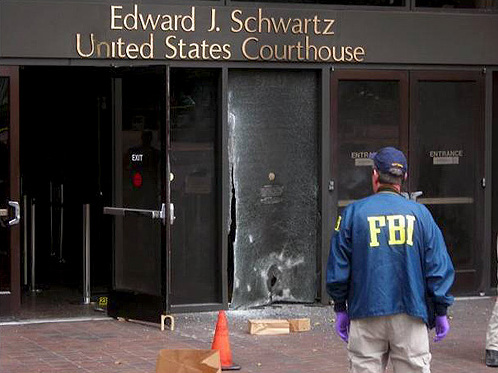
A U.S. attorney's office at the southwest border publishes a running weekly count of border-related criminal cases filed, and those counts have been offered as evidence about the state of the border itself. The district-level reporting Daily Pol holds supports a narrower reading. In the same federal district, the growth is concentrated in the least serious offense in the set, and prosecutions for weapons, drugs, fraud and child exploitation were all tracking downward at the same time.
What could not be verified. The weekly release named in this story's assignment, reported as totaling 107 border-related cases, could not be retrieved. The justice.gov host returned an authorization error to Daily Pol's automated request, and the release appears in no search index Daily Pol checked. Nothing here should be read as confirming that release, its total or its contents. No government primary source could be obtained for any figure below; every source in Daily Pol's holdings for this story is secondary.
The claim. A snapshot Daily Pol holds of an inewsource article dated Aug. 28, 2025 contains the sentence: "These stats tell a very simple story: the border is now secure thanks to the Trump Administration". That snapshot is a list of extracted fragments, and it does not mark which lines are the publication's own reporting and which are speech it was quoting from an interviewee. Daily Pol therefore cannot establish from the snapshot who said that sentence, and does not attribute it to any individual. The date is part of the record: the sentence is from August 2025, roughly a year old, and is not a statement about this week.
The record, August 2025. The same inewsource snapshot records that federal immigration prosecutions in San Diego and Imperial counties had passed 3,200 from October through June, a pace it describes as more than double the previous fiscal year, with illegal-entry prosecutions on pace to rise by more than 800 percent. It records immigration prosecutions as roughly three-quarters of the office's new cases, and states that most prosecutions were for illegal entry, a misdemeanor on a first offense, and illegal reentry, a felony. The same caveat applies to each of these lines as to the sentence above: the snapshot does not separate the publication's reporting from quoted speech. It also lists narcotics and drug prosecutions down about 12 percent and white-collar crime down about 17 percent, and one further category described as on pace to be nearly 50 percent lower than the year before, whose subject the snapshot does not identify. Daily Pol does not guess at that subject.
The record, January 2026. A second inewsource snapshot, dated Jan. 5, 2026, reports that prosecutions under the misdemeanor illegal-entry charge, Section 1325 of Title 8 of the U.S. Code, were on track to be about nine times higher. The snapshot does not state inside that sentence what the multiple is measured against; a nearby line gives a previous-fiscal-year total of about 1,900, but the snapshot does not tie that figure to the illegal-entry multiple, and Daily Pol does not treat it as the baseline. The same article reports weapons prosecutions on track to be down about 40 percent, white-collar prosecutions down 20 percent, drug prosecutions down about 9 percent, and prosecutions under Project Childhood Safe, a national initiative against child sexual exploitation, down about 27 percent. It reports that most of the immigration cases involved no offense beyond crossing the border, a misdemeanor on a first offense and a felony for people found in the country after a prior deportation, and it describes the Southern District of California, covering San Diego and Imperial counties, as one of the nation's busiest federal districts. John D. Kirby, a federal criminal defense attorney in San Diego who the article says previously worked as a federal prosecutor in the area, said the diversion of federal resources would affect agencies' ability to open new drug and white-collar investigations, and said he had seen some narcotics cases handed to local prosecutors. The article cites an estimate by the Cato Institute, a libertarian research organization, that more than 25,000 federal agents had been moved to immigration enforcement.
The two snapshots do not agree. They were published four months apart and give different declines for the same categories: weapons down nearly 50 percent in one reading versus about 40 percent in the other, white collar 17 percent versus 20 percent, drugs 12 percent versus 9 percent. Daily Pol keeps each figure with its own article rather than merging them. The direction is consistent across both; the magnitudes are not, and a reader should treat any single percentage as a snapshot of a projection, not a settled count.
The weekly totals themselves. Only one weekly total is usable in the material Daily Pol holds for this district: a KYMA report dated July 17, 2026 recording "111 border-related cases this week", described as including bringing migrants into the country for financial gain, reentry after deportation, and drug importation, with a sample of arrests. The body of that snapshot names no office and no judicial district; the office and the state appear only in the report's headline and web address, and KYMA is a Yuma, Arizona outlet whose coverage area includes Imperial County. Daily Pol's holdings contain one further case-count headline, an Epoch Times report on hundreds of border-related cases filed across Texas, Arizona and California, but the body of that snapshot is a single unrelated sentence and cannot support a claim here.
Filings are not outcomes. A March 19, 2026 inewsource report on a different set of charges in the same district records that almost half of one year's assault-on-a-federal-officer cases, 10 of 22, were later dismissed, though they could be refiled, against two dismissals out of 25 cases the prior year, about 8 percent. It reports that 38 percent of such cases filed in five districts across the West Coast, Washington, D.C., and Illinois ended in dismissals or acquittals since Jan. 20; the snapshot gives that date without a year, and Daily Pol cannot supply one from the material it holds. It records that none of the district's cases had yet ended in a conviction and that most of the alleged assaults caused no injury to an agent. Those are charges, not verdicts, and no defendant is named here. The same snapshot carries an enforcement statement, whose speaker it does not name, that anyone who assaults a federal officer should expect "an arrest on federal charges will soon follow."
Scale. Transactional Records Access Clearinghouse figures record 5,649 defendants charged with immigration offenses in U.S. district courts nationwide in May 2026.
Analysis. On the facts above, a weekly count of border-related cases filed is a measure of a charging decision before it is a measure of a border. The bulk of the district's growth sits in a first-offense misdemeanor, and the categories that require investigation over months - narcotics, weapons, fraud, child exploitation - moved the other way in the same office over the same period. That is an opportunity cost no single weekly total reports, because a weekly total has no denominator, no comparison to prior years and no outcome data. The reasoning also runs in a circle: filing volume is offered as proof the border is secure, while a high volume of border-crossing prosecutions is equally consistent with a border people are still crossing. And the district's assault cases show what a filing count omits at the other end, where a dismissal rate moved from roughly 8 percent to nearly half in a year.
A checkable prediction. If the weekly cadence holds, another weekly border-case total from the U.S. Attorney's office reported by KYMA will appear before Sept. 30, 2026, and Daily Pol predicts it will again report only cases filed, with no conviction, dismissal or acquittal figures for the cases it counts. If any such weekly total published on or before that date reports outcomes, this prediction is wrong.
Editor's note. Daily Pol had not sent a request for comment to the U.S. Attorney's Office for the Southern District of California as of the time of drafting, and no reply has been received. Under Daily Pol's charter this piece does not publish until an editor has sent that request and recorded it; the office is named in the ledger as the subject owed a reply. On the Transactional Records Access Clearinghouse: the snapshot Daily Pol holds states only that U.S. Attorneys recorded the May 2026 defendant count, and says nothing about how the clearinghouse compiles its data. The description of it as a Syracuse University research clearinghouse rather than a government publication is Daily Pol's own characterization, drawn from the source's publisher line, not a claim the snapshot makes. A one-line percentage about federal immigration convictions in May 2026 also appears in that snapshot; because the source does not say what it is a percentage of, it is not reported here.