Immigration & Border · The Record
CBP counts 59 new miles of primary border wall since January 2025; officials plan 667 more
The agency's own mileage, and the weekly pace the White House claims for itself, do not reach the finish date administration officials have described.
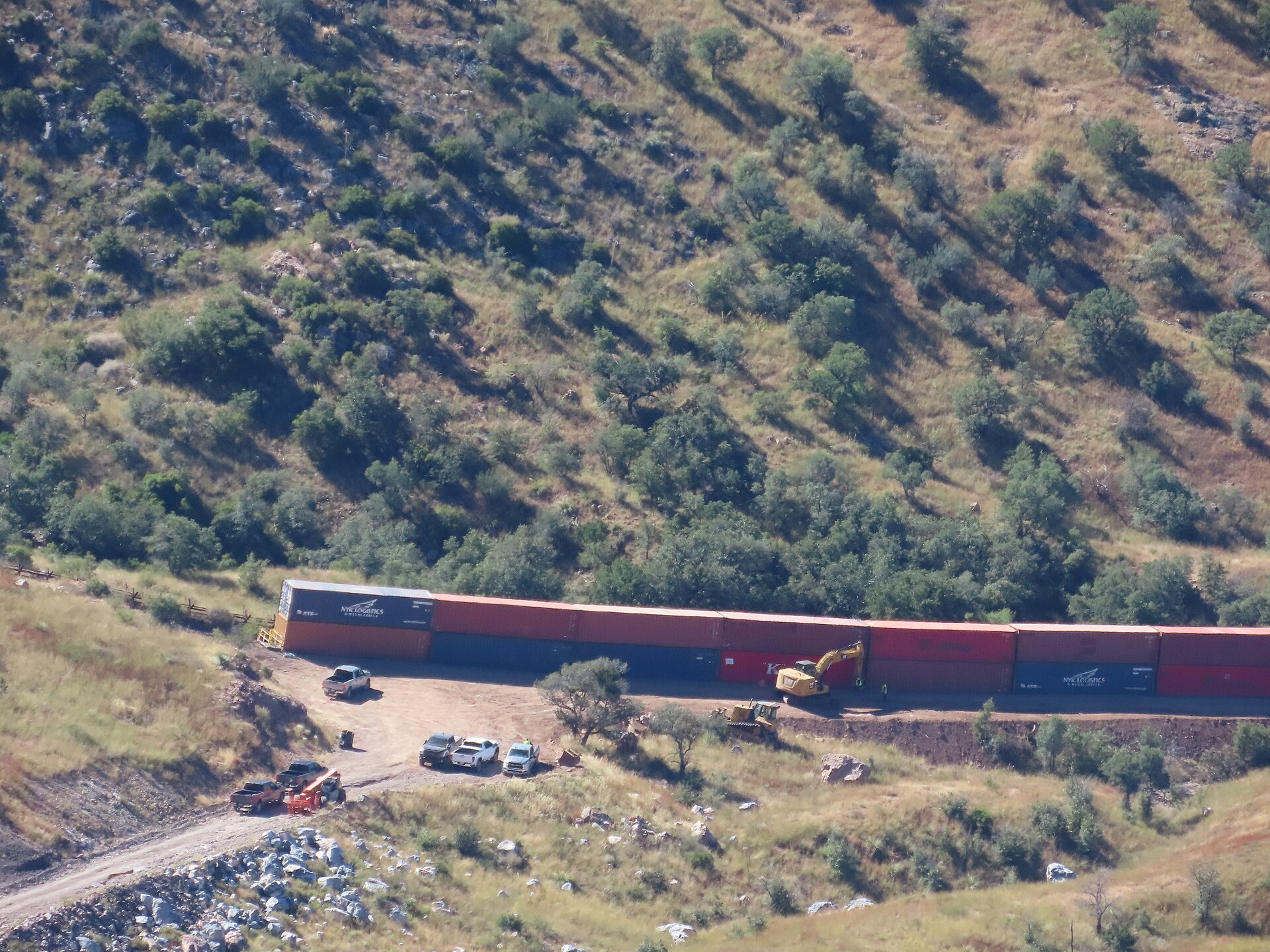
The record for the border wall in New Mexico begins with two notices in the Federal Register.
On October 8, 2025, the Department of Homeland Security published a determination covering a segment described as "Starting at approximately Border Monument 49 and extending north and then east to Border Monument 1." On December 18, 2025, DHS published a second determination covering ground "Starting at Border Monument 73 and extending east and north to Border Monument 47." The December notice carries the signature of Homeland Security Secretary Kristi Noem.
Each notice states an "acute and immediate need to construct additional physical barriers and roads" in its project area. Each then sets aside, in their entirety, the statutes the notice lists, along with any other laws, regulations or legal requirements that would otherwise apply, for construction work that includes earthwork, roads, drainage, lighting, cameras and sensors. The waiver is the instrument that turns a review calendar into a construction calendar. Any completion announcement in these segments rests on it.
The claim
TIME reported on August 6, 2026 that administration officials have said work on the primary portion of the wall is set to be finished as soon as next year. The same report states that CBP Commissioner Rodney Scott said the secondary wall system will be completed by July 2028. A White House official told TIME that CBP is currently building "around 7 miles of barrier per week on average," and that the rate is expected to rise significantly as more projects start.
The record
The figures below come from CBP tracking and from CBP and White House officials, as reported by TIME on August 6, 2026.
- About 700 miles of primary wall now stand along a border of nearly 2,000 miles.
- In January 2025 there were roughly 644 miles of primary wall and 75 miles of secondary wall in place.
- Since January 2025, 59 new miles of primary wall and 42 new miles of secondary wall have been built - 101 miles of barrier in all.
- CBP plans roughly 667 additional miles of primary wall and 461 additional miles of secondary wall, according to a White House official.
- The One Big Beautiful Bill appropriated $46.5 billion for the buildout, available through September 30, 2029. A CBP official said $33.6 billion of it has been awarded in construction contracts.
- The agency has said it expects 250 miles of "new barrier" to be complete by September 30 this year.
The arithmetic, compared like with like
The 7 miles a week the White House describes is barrier of both tiers, primary and secondary. The comparable delivered figure is therefore also both tiers: 101 miles over the roughly 81 weeks since January 20, 2025, or about 1.25 miles a week. The claimed current rate is about 5.6 times the average actually delivered over the term to date.
Now apply the claimed rate as generously as it can be applied. Assume every one of those 7 weekly miles is spent on primary wall and none on secondary. The 667 remaining primary miles then take about 95 weeks, running into mid-2028 - roughly a year past the finish described as "as soon as next year."
Build the two-tier system the appropriation funds, and the remaining 1,128 miles at 7 miles a week take about 161 weeks, or roughly 3.1 years from today. That lands near September 30, 2029, the date the $46.5 billion stops being available. The schedule and its own funding cliff arrive together, with no slack. At the pace delivered so far, about 1.25 miles a week, the same 1,128 miles would take about 17 years.
The July 2028 secondary date is a separate test. Taken by itself, 461 secondary miles at 7 miles a week is about 66 weeks of work, which would finish well before July 2028. Whether it can be met alongside the primary schedule depends on sequencing that no source in this set states. That is the point: one weekly rate cannot be spent twice.
The nearest checkable date
September 30, 2026 is seven weeks away. Reaching 250 miles of new barrier from the 101 miles CBP reports built would require about 149 miles in roughly 7.6 weeks, or close to 20 miles a week - nearly three times the rate the White House claims for the present. The sources here do not define whether "new barrier" counts the same categories as the primary and secondary mileage above, and that caveat should travel with the comparison. Even allowing generous definitions, the gap is not a rounding matter.
Prediction: CBP will not report 250 miles of new barrier completed as of September 30, 2026. Checkable by October 31, 2026, against CBP's own published tracking.
Prediction: CBP tracking will show fewer than 1,367 miles of primary wall in place on December 31, 2027. Checkable by January 31, 2028.
The gap the plan does not close
Analysis, grounded in the figures above: 700 miles built plus 667 planned is 1,367 miles. The border runs nearly 2,000 miles. On the agency's own stated plan, a completed primary wall is roughly two-thirds of the border, not a continuous barrier across it. That is a definitional gap rather than a scheduling one, and no acceleration closes it.
Technology counted alongside steel
The Washington Office on Latin America reported in October 2025 on a contract that would "add 230 miles of Smart Wall and nearly 400 miles of new technology," with system attributes it described as "30-foot steel barriers, waterborne barriers, patrol roads, lights, cameras, and advanced detection technology." As analysis: when mileage is counted as system attributes rather than as steel in the ground, the word "completed" carries a different meaning than it did in the first-term count. Readers checking the 2027 and 2028 dates should ask which meaning is being reported.
Water and permits
WBUR reported on July 10, 2026 on water use for wall construction in New Mexico. Its account states the state rule plainly: "To drill water wells, you need permits from the state engineer." The same report records a federal posture of "working with New Mexico to develop a groundwater management strategy." Daily Pol could not verify from the material available to this desk whether any specific well serving wall construction was drilled without that state permit, and does not assert it here.
Historical context
About 458 miles of wall were installed during the first Trump administration, according to a 2023 Government Accountability Office report cited by TIME; the administration at the time described more than 450 miles complete. Almost all of that was replacement or reinforcement of existing barrier in already-fenced corridors. The 667 miles now planned would be roughly 1.5 times the entire first-term output, on a schedule about a quarter as long.
What this desk could not verify
This piece was begun in pursuit of a reported announcement that a wall segment near Lordsburg, New Mexico was complete, carried by Nexstar-owned outlets. Those pages returned HTTP 403 to this desk and cbp.gov was not reachable, so the announcement is not asserted as fact here and nothing above depends on it. Reported details of a January 2026 contract award for the El Paso 4 project were likewise unverifiable and are omitted. The analysis above is built only on CBP figures published by TIME, on the two Federal Register determinations, and on the WBUR and WOLA reports cited.
Right of reply
This article tests dated public statements by named officials against figures their own agency supplied. CBP, the Department of Homeland Security and Commissioner Scott have made no response to this desk. A right-of-reply request is flagged as required and will be documented by an editor before publication; any response received will be appended here in full.