Odd & Viral · The Record
A pizza puzzle's jump from 16 to 31 matches the OEIS dataset; its 1949 source is cited with two authors
Scientific American credits the sequence 1, 2, 4, 8, 16, 31 to Leo Moser alone. The OEIS b-file confirms every term. The citation for the 1949 paper names Moser and W. Bruce Ross.
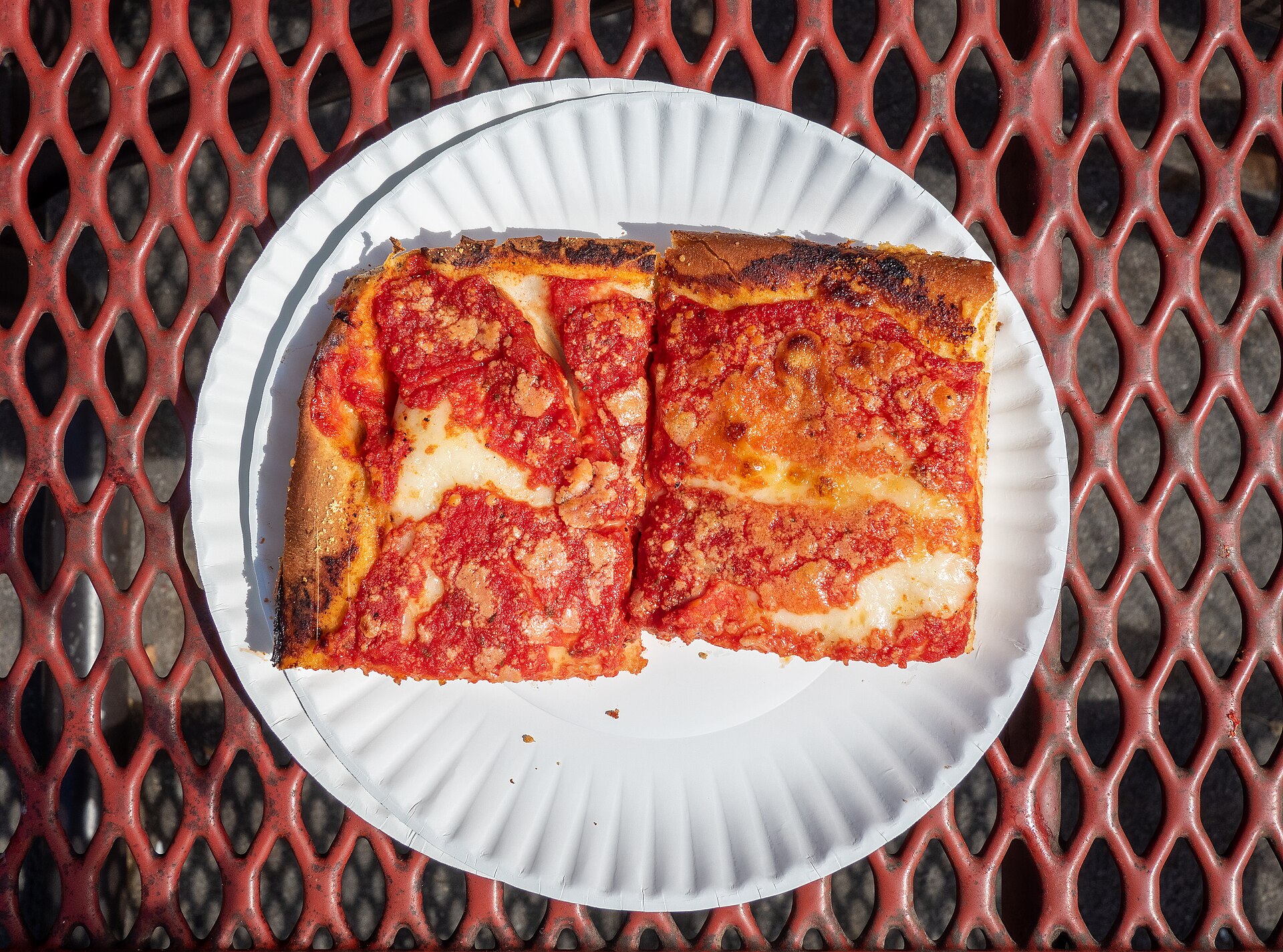
The sequence 1, 2, 4, 8, 16 behaves itself for exactly five terms. Scientific American's explainer on Moser's circle problem invites the reader to guess the sixth, records that most people would guess 32, and then produces 31 instead. The page states it directly: "this sequence, which was devised by number theorist Leo Moser in 1949, takes a surprising turn: 16 is followed by 31."
Two separate assertions are bolted together in that one sentence. The first is numerical: the doubling breaks at the sixth term, and the run continues 31, 57 and 99, under the designation A000127 in the On-line Encyclopedia of Integer Sequences. The second is historical: a named mathematician devised the thing, in a named year, alone. The first is testable against a dataset. The second is testable against a bibliographic record. They do not both come out the same way.
The setting is a general-audience explainer, and the pizza is the pedagogy. The problem, the article says, can be used to "divide a pizza into one, two, four, eight, 16 or 31 slices" - the joke being that the sixth term comes up one slice short of the 32 the reader has already mentally eaten. The explainer also states that Moser used the example to warn against drawing hasty conclusions from supposed patterns, which is the article's characterization of Moser's purpose rather than any words captured from him. The captured page carries no quotation attributed to a named speaker at all. It does identify people by name - Leo Moser, whom the sentence quoted above calls a number theorist, and a byline giving Manon Bischoff as the writer and Daisy Yuhas as the editor - but it attributes no words to any of them.
Underneath the pizza sits a counting problem with a precise statement. Wikipedia's article on dividing a circle into areas defines it as a question about "choosing n points along the circumference of the circle and joining each pair of points by a straight line" and asking how many regions result. Wolfram MathWorld poses the same count for the pieces a circle is divided into when points on its circumference are joined by chords, subject to a condition it states plainly: "with no three internally concurrent." Wikipedia adds the observation that the first five terms coincide with a geometric progression and that the two sequences part company from the sixth term onward. None of the captured records walks through a derivation of 31; each of them states the count and moves on.
The record that tests the numerical half is not prose. OEIS stores the terms of A000127 in a static plain-text file, b000127.txt, and that file is what this desk fetched. In it, each line is a pair: the index on the left, the value on the right. Lines five through eight read 5 16, 6 31, 7 57, 8 99. Term for term, index for index, that is the Scientific American claim. There is no rounding to argue about and no methodology to interrogate; the file either says 31 at position six or it does not, and it does.
The file keeps going, and the trap keeps working further down the column. Line nine gives 163. Line ten gives 256, which is itself a power of two - a small trap of its own, since a reader still doubling from 16 would have arrived at 512 by that point and might take 256 as partial credit. The capture runs to line fifteen, 1471.
What the b-file cannot do is settle anything about 1949. It carries no author, no year, no proof, no citation and no prose. It is a column of integers, and integers do not know who found them. The origin half of Scientific American's sentence has to be tested somewhere else entirely.
View the data
| Value (regions) | |
|---|---|
| n=1 | 1 regions |
| n=2 | 2 regions |
| n=3 | 4 regions |
| n=4 | 8 regions |
| n=5 | 16 regions |
| n=6 | 31 regions |
| n=7 | 57 regions |
| n=8 | 99 regions |
Source: OEIS b-file b000127.txt for sequence A000127 · Daily Pol graphic
That somewhere turns out to be a bibliographic line rather than a document. Wikipedia's citation for the 1949 source opens with two names, printed as "Moser, Leo; Ross, W. Bruce", and continues: Mathematical Miscellany, in Mathematics Magazine, volume 23, number 2, pages 109 to 114, dated November-December 1949, JSTOR 3219224. Two authors, one of whom appears nowhere in the explainer and nowhere in the name the problem is known by.
The single-name habit is visible right across the captured record, which is the point worth noticing. An arXiv preprint by Carlos Rodriguez-Lucatero, revisiting the formula as a fourth-order difference equation, describes the failure of inductive reasoning "as was pointed out by Leo Moser in the Mathematical Miscellany in 1949" - same year, same venue, one name. MathWorld is the only captured source that hedges the eponym at all, opening with "A problem sometimes known as Moser's circle problem". Its reference list places the puzzle in company: R. K. Guy, The Strong Law of Small Numbers, in the American Mathematical Monthly volume 95, pages 697 to 712, 1988, a title that names the hazard even though the paper itself is not in what we captured; Conway and Guy's The Book of Numbers, pages 76 to 79, 1996; and Sloane's entry for the sequence as A000127/M1119.
What follows is analysis, drawn only from the sources above. Nothing in the Scientific American piece is arithmetically wrong; none of the numbers in the column are off by so much as a region, and the b-file backs the explainer's terms exactly where a check can reach. The distance between claim and record is carried entirely by a verb. "Devised by" assigns authorship to one person, and the only captured citation for the item being credited names two. The eponym itself carries one name, and the arXiv abstract does the same, so the fair reading is a convention being inherited rather than a fact being got wrong. It is still a convention that costs a co-author half a footnote every time it is repeated.
Three things a reader can check without taking this desk's word for any of it. The b-file at oeis.org is public and static, and line six of it either reads 31 or it does not. JSTOR 3219224 is the 1949 item itself, and its title page would settle whose names are on it - which the capture used here could not. And the sentence in the explainer is still there to watch: this piece predicts that on December 31, 2026, it will still credit Leo Moser alone, with no second name added, because nothing in the record suggests the convention is about to change for one pizza story.