Politics & Government · The Record
White House message puts the Fort McHenry bombardment at 27 hours; the Park Service says 25
An anniversary message published under a September 2026 path on whitehouse.gov puts the 1814 bombardment at 27 hours. The National Park Service page for the fort says 25, and so does the first-person account the American Battlefield Trust publishes as a primary source.
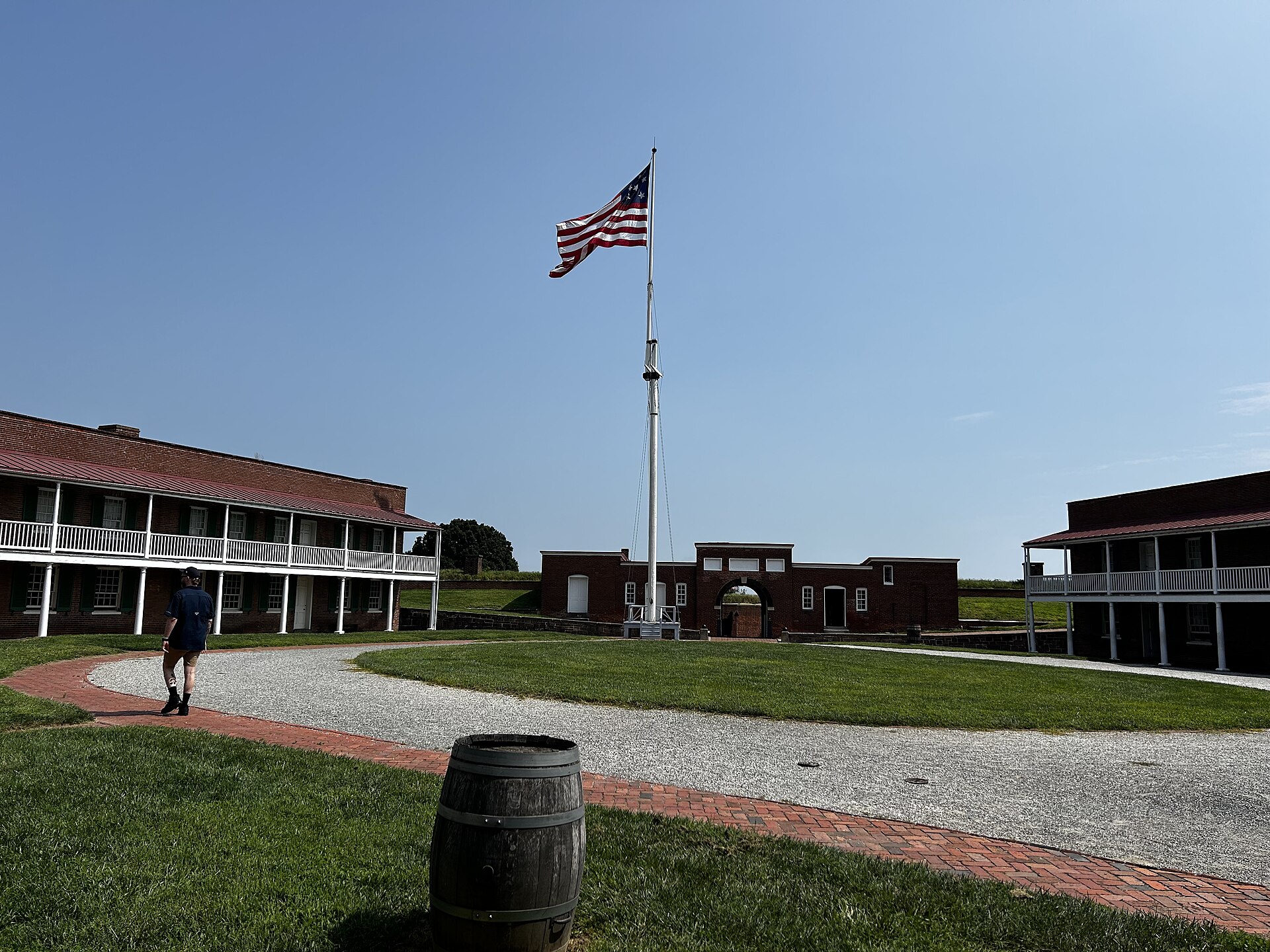
A message published under a September 2026 path on whitehouse.gov retells the Battle of Fort McHenry in six paragraphs of commemorative prose. On one number it parts company with the federal agency that publishes the fort's own pages, and the distance is two hours.
The message is an anniversary statement, not a history paper, and it argues a case: that the fort held and that the defenders' example is a standing obligation. It states that 1,000 American patriots defended the young Nation's sovereignty at the battle and that they halted the British invasion of Baltimore, which it calls a critical turning point in the War of 1812. It places the start of the naval assault on the morning of September 13, describes exploding rockets and cannonballs, and has the British abandoning the attempt the next morning and sailing away in retreat. Francis Scott Key appears in it as an American lawyer watching from a nearby ship, fearing overnight that the fort had fallen. The message counts 212 years since the battle and closes on the national anthem's own words, framing the anniversary as an occasion to reflect, in its phrase, "on 250 years of glorious American Independence."
One sentence in that account is testable against other federal and primary material, and it is the one carrying the clock. The message states that the soldiers at the fort endured the fleet's fire "For 27 long, grueling hours."
The National Park Service, which publishes the fort's pages on nps.gov, puts it at two hours less. Its bombardment page describes the bomb ships and the Erebus moving within two miles of the fort and beginning a bombardment that, in the page's words, "would last for the next 25 hours." The same page supplies a start time the message does not: shortly before 6:30 a.m. on September 13, the vessel Terror tested the range and fired the first bomb at the American defenses.
The 25-hour figure is not a modern reinterpretation layered on the event. The American Battlefield Trust publishes, as a primary source, a first-person account of the bombardment whose writer the capture does not identify. The capture of that page returns the account as four bare fragments rather than as a continuous document, and it carries no date, no author line and no named recipient - a limit worth stating plainly, because the fragments are doing real work here. One of them gives the duration as "25 hours (with two slight intermissions)." Others in the same capture count the enemy's shells at between fifteen and eighteen hundred and give the writer's own losses as "only four men killed, and 24 wounded", all of whom the writer expected to recover.
What the record does not settle is where 27 came from. None of the four non-White House captures in this file offers a 27-hour count, an alternative clock reading, or a rival end time, and the captured body of the message attaches the figure to no source at all. Two hours could be the difference between counting from the first ranging shot and counting from the general opening of fire, or between the last gun and the British withdrawal - but that is a hypothesis this desk cannot test on the documents in hand, and the captures do not raise it.
The head count is a different kind of problem, and it is internal to the government rather than between branches. The message's figure of 1,000 defenders matches the Park Service's Defenders page, which opens by describing "The 1,000 men who defended Fort McHenry" and goes on to sort them into regular army artillery, militia units of citizen soldiers, and men of the Chesapeake Flotilla and Sea Fencibles who ended up manning defenses to keep the fort from falling. That page adds a detail the message does not: nearly a third of the defenders were immigrants. But the Park Service's own bombardment page counts reinforcements from four US Army regiments, plus three Baltimore artillery companies from the Maryland Militia, and puts "close to 1,200 men" at the fort. The Battlefield Trust capture gives a floor rather than a figure - "more than 1000 effective men", with no side named - and a floor above 1,000 neither confirms the Defenders page's count nor reaches the bombardment page's, so it cannot settle which is right. On the head count the message picks one of two numbers its own government publishes; on the clock it picks a number neither of them publishes.
The rest of the message survives the comparison. Its September 13 morning start is consistent with the Park Service's 6:30 a.m. ranging shot, though the message itself gives no time of day. Its arithmetic holds: 212 years after 1814 is 2026. Its central claim - that the fort was not taken - is what the Park Service's Defenders' Day page records as the successful defense of the city from British attack in 1814, alongside the writing of the national anthem. Read as analysis rather than as reporting, that pattern matters: a single outlier figure in an otherwise accurate document is a different thing from a careless document, and this one is the former.
The anniversary the message marks is also a local observance with a longer paper trail than the message itself. The Park Service calls Defenders' Day Baltimore's oldest holiday and dates its celebration to 1815, the year after the battle, honoring what the page calls generations of Fort McHenry's defenders. The capture says nothing about how, or by whom, the date has been marked since.
All five documents are live at fixed addresses, so the comparison is one any reader can repeat. The prediction this desk will stand behind: as of October 15, 2026, the White House message will still read 27 hours and the Park Service bombardment page will still read 25, with neither figure amended to match the other.