Science & Technology · The Record
NASA says SkyFall mission is expected to launch in late 2028 aboard the first fission-powered interplanetary spacecraft
A NASA Science artist's-concept page attaches a date and a specific ride to a Mars helicopter concept AeroVironment still describes in the conditional; the captured passages state no helicopter count and one caption line is broken.
NASA Science's artist's-concept page for the SkyFall Mars helicopters, captured for this article on Aug. 8, 2026, states that the mission "is expected to launch aboard NASA's Space Reactor-1 Freedom in late 2028."
NASA's page for that spacecraft describes it as "humanity's first fission-powered interplanetary spacecraft" and states that it "will demonstrate nuclear electric propulsion in deep space."
What the record says
The artist's-concept page is a caption, and it describes the picture in instrument terms rather than mission terms. Green frequency waves in the image stand for the collection of subsurface radar data, which NASA's caption attributes to the helicopters' large antennas. Red beams stand for near-infrared imagery of regolith and other surface features. The captured text does not say what platform carries the near-infrared instrument.
That second sentence is also defective as published. It reads: "The red beams depict collect near-infrared imagery data from regolith (crushed rock and dust) and other surface features." The verb sequence is broken, and it was still uncorrected in the page captured on Aug. 8, 2026.
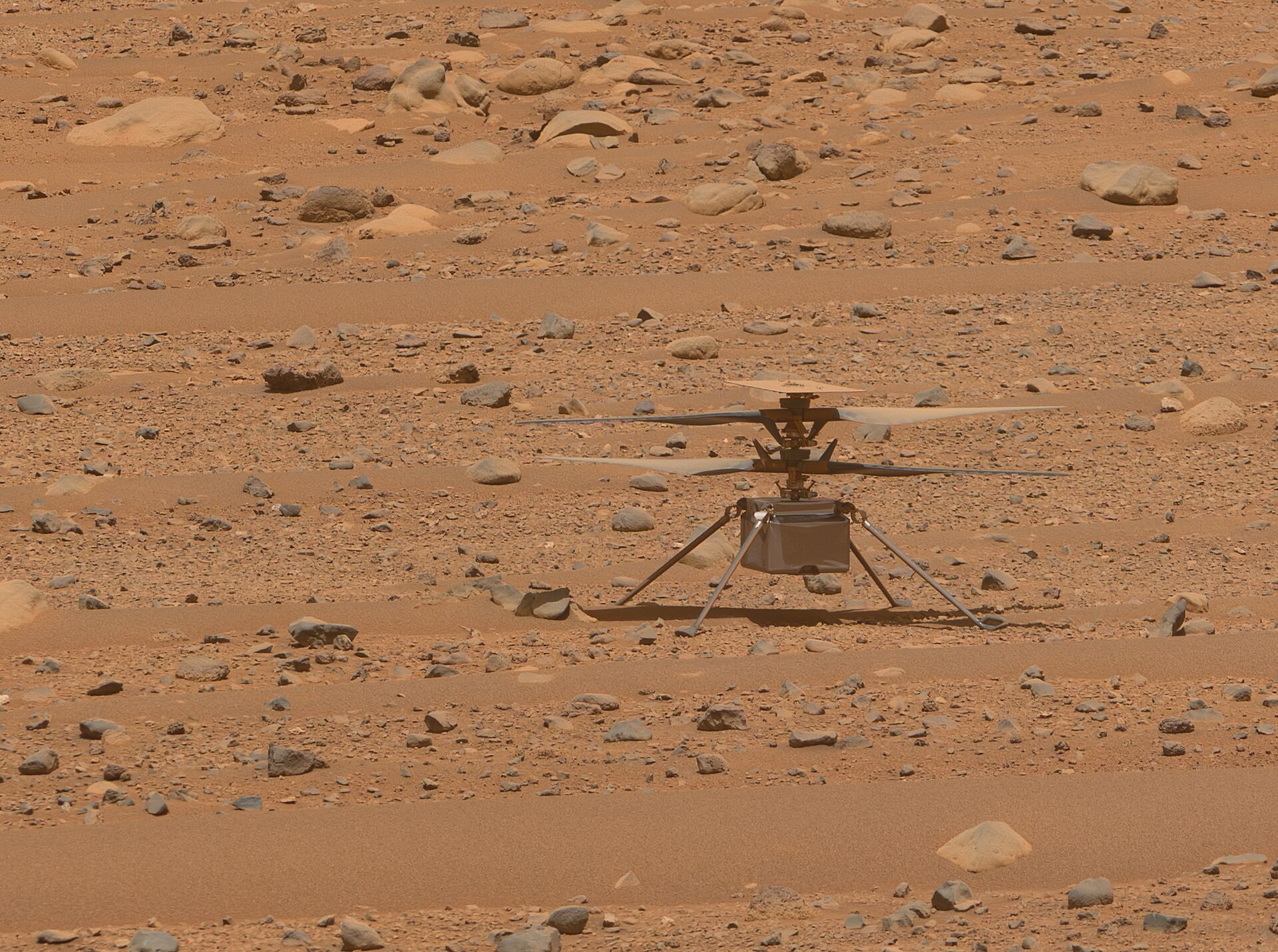
The caption's history line does not name a craft in the passage captured here. It states that the aircraft flew 72 times across nearly three years, and that those flights showed controlled, powered flight to be possible in the thin air of Mars.
Two other documents name the predecessor. NASA's SkyFall mission page states that AV engineers previously worked with the Jet Propulsion Laboratory to design and build the Ingenuity rotorcraft, and that AeroVironment of Arlington, Virginia, will co-design and co-manufacture the SkyFall helicopters with JPL. AeroVironment's July 2025 release states that Ingenuity "established the United States as the first and only country to achieve powered flight on another planet."
What the company says
AeroVironment announced the concept with JPL in July 2025. William Pomerantz, head of space ventures at AeroVironment, stated in the company's release: "Skyfall offers a revolutionary new approach to Mars exploration that is faster and more affordable than anything that's come before it." The word "revolutionary" is the company's, not this article's. Military & Aerospace Electronics carried the same sentence in its report on the unveiling.
AeroVironment's current Skyfall solution page describes the deployment scheme in the conditional. It states that the concept "Would demonstrate an innovative mid-air Skyfall maneuver for deployment that dramatically reduces surface delivery costs," and that it "would be ready for launch by 2028."
What the captured documents do not say
None of the passages captured from these five primary documents states how many helicopters SkyFall carries. NASA's caption and mission page refer to the helicopters in the plural, with no count attached. AeroVironment's current solution page, in the captured text, gives no number either.
Analysis
Read against each other, the two sets of documents are written in different grammatical registers, and that is the substantive change in the public record between July 2025 and August 2026. The manufacturer's page still says the system "would be ready" - a conditional about a concept. NASA's caption says the mission "is expected to launch," names the vehicle and names the window. An expectation with a ride attached is a stronger statement than a readiness claim, and it is the agency, not the vendor, making it.
The cost claim sits on the weaker side of that line. AeroVironment attaches the reduction in surface delivery costs to the mid-air maneuver, and states it with the same conditional verb it uses for readiness. Nothing in the documents captured here records that maneuver being demonstrated; the pages describe what the system would do, and this article can say only that the captured record contains no demonstration of it.
The schedule also inherits a dependency that a rotorcraft concept did not originally carry. By NASA's own description, the ride is itself a first-of-its-kind demonstration: a fission-powered interplanetary spacecraft proving nuclear electric propulsion in deep space. A helicopter payload with a late-2028 date is now downstream of a propulsion demonstration that has not flown, which means the two schedules can only be as firm as the weaker one.
One smaller signal concerns the state of the record itself. A caption sentence with a broken verb sequence, published on a NASA Science page and still uncorrected when the page was captured, suggests the artist's-concept release has had less editorial handling than the mission pages it points to. That is a detail any reader can check by loading the page.
Falsifiable prediction: if the date in NASA's caption holds, Space Reactor-1 Freedom will have launched carrying the SkyFall helicopters on or before Dec. 31, 2028. If NASA's mission pages on that date show no launch, the late-2028 line in this caption will have slipped.
Right of reply
Daily Pol has not contacted AeroVironment or NASA's Jet Propulsion Laboratory about this article. No comment request has been sent, and none is recorded. The claims ledger marks a documented request to both as required before publication.