Disasters & Accidents · The Record
Washington restored $60 million in wildfire funding; state proclamation records more than 1,000 fires and about 425,000 acres
Commissioner of Public Lands Dave Upthegrove said he heard repeatedly that the funding mattered for, among other things, protecting urban air quality. A statewide emergency proclamation puts the year-to-date total at more than 1,000 fires and roughly 425,000 acres, the most since 2021.
A Washington State Department of Natural Resources release states that the Legislature's supplemental budget restored $60 million in wildfire prevention and preparedness funding that had been cut the year before, and that Commissioner of Public Lands Dave Upthegrove commended legislators for doing it. "Wildfire touches everyone in Washington," Upthegrove said in that release.
In the same release, Upthegrove described what he heard while traveling the state during his first year in office: that the funding was critical for keeping frontline fire districts equipped, for reducing fire danger in communities near wildlands, and for "protecting the air quality of our urban centers." That last phrase is the one this piece tests, because it is the only line in the record that ties a prevention appropriation to what people in Seattle breathe.
An earlier department page, published under a headline about restoring wildfire, forest health and community resilience funding, carries a blunter version of the same argument: if the money is not restored, "we're going to see more fires and we're going to see bigger fires." The page also states that preventing and responding to catastrophic wildfires "is a core, basic public safety function of government." The snapshot of that page names no speaker for either sentence, so both are attributed here to the page and not to a person.
The record
A proclamation release from the office of Gov. Bob Ferguson records the season's running totals. The snapshot carries no issue date; it refers to Friday, July 31 and quotes Upthegrove saying the state had just started August, which places it in the first days of the month. In it, Ferguson declared a statewide state of emergency over drought, high temperatures and high winds, with a prohibition on most outdoor and agricultural burning through Sept. 30, 2026.
The figures in that release: more than 1,000 fires had burned approximately 425,000 acres, described as the most since 2021 according to the Department of Natural Resources, with more than 200,000 acres burning in 12 large fires at the time of the proclamation. The state was in what the release calls a record-setting fourth consecutive statewide drought. "Our record-setting drought and high winds are creating dangerous conditions across the state," Ferguson said. Upthegrove, in the same release, said: "This year has already been one of our busiest wildfire years on record, and we just started August." The release records 110 Washington National Guard members activated on July 31, supplementing 27 helicopter crew members activated earlier in July.
A separate release from the Governor's office records a federal emergency declaration granted at the state's request. The snapshots do not establish its date relative to the state proclamation, and the body text in the snapshot names no speaker for its quotation - the attribution to Ferguson rests on the release title alone. That quotation: "We are laser-focused on getting assistance to those Washingtonians who have lost so much."
Put the two records side by side and a timeline appears that neither one contains on its own: a department warning that failure to restore the money would mean more and bigger fires, the restoration of $60 million in full, and then a fire year that by the proclamation's own count was the worst start since 2021. One hedge is required and it is not small. The archived DNR release carries no date either. It describes the appropriation as a supplemental budget restoring money cut "last year," which implies a session preceding these fire figures, but no snapshot here fixes the date of passage, so the ordering is inferred from the release's own wording rather than established.
What the Puget Sound record actually measures
The Puget Sound Clean Air Agency's data summary states that in 2025 the region was impacted for three days by wildfire smoke, and that fine particle levels at all sites stayed within the federal standard of 35 micrograms per cubic meter through the year except for a single exceedance on Sept. 24, 2025 at the Darrington site. The agency's own health goal of 25 micrograms per cubic meter was exceeded on two September days because of wildfire smoke, and on up to six winter days because of wood smoke from home heating. The summary also records one day in Snohomish County in the unhealthy-for-sensitive-groups category from smoke impacts - the single localized health-category figure in this record.
Against that, the same agency states: "Since 2015, our region has experienced unprecedented wildfire smoke, resulting in the highest fine particle levels we've recorded since monitoring began in 1980."
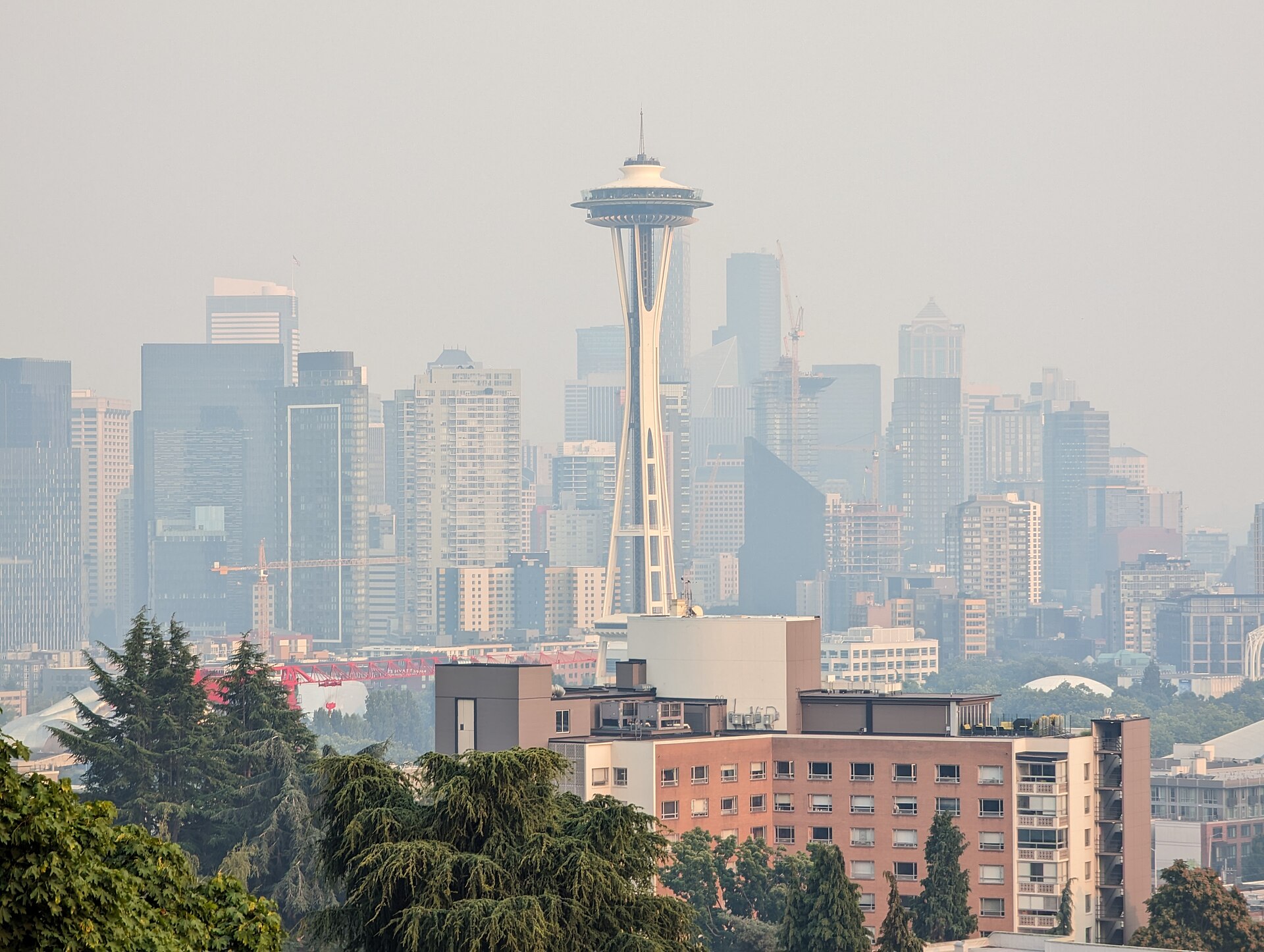
This piece started from a question about how long clear skies and fresh air will hold over Seattle. The snapshots here cannot answer it and do not measure current conditions in the city, so no characterization of today's Seattle air is offered. What they do supply is weather. A Department of Ecology post records a strong high pressure system off the coast expected to persist, producing "hot and dry conditions." The interagency Washington Smoke Information blog records that "intermittent clearing will occur in some areas" while "wind gusts will likely lead to more fire growth," with hot, dry, windier conditions east of the Cascades.
Analysis
On this record, the variable that decides whether western Washington sees smoke is where the wind puts it, not how much the state spent on prevention. The clearing described in the interagency post is transport, and transport reverses. A clean week in Seattle is therefore not evidence that the $60 million worked, and a smoky one would not be evidence that it failed.
The fairness limit runs the other way too, and it is the more important one. Money appropriated in a supplemental budget cannot plausibly change the acreage that burns in the same season. Fuel-reduction work, equipment purchases and community resilience programs run on multi-year clocks. Nothing in this record supports the claim that the restored funding failed; what the record supports is narrower - that the restoration and the worst fire start since 2021 occupy the same year, and that a single quiet air-quality year in Puget Sound, measured against a monitoring baseline going back to 1980 and a decade the agency itself calls unprecedented for smoke, is noise rather than a trend.
A falsifiable test, then. Prediction: the Department of Natural Resources' end-of-season acreage figure for 2026 will exceed the approximately 425,000 acres recorded in the emergency proclamation, given that 12 large fires were still burning when it was issued. Checkable by Nov. 1, 2026 against DNR's published season totals.
Sourcing note
Every fact above comes from primary agency releases and datasets listed in the ledger. No comment was sought from Commissioner Upthegrove, Gov. Ferguson or their offices for this piece, and none is represented here as having been given. The snapshots do not state party affiliation for either official, so none is given. The originating local coverage of the Seattle weather question was not readable and nothing is attributed to it. Two dating gaps are disclosed above rather than papered over: the emergency proclamation release carries no issue date beyond its references to Friday, July 31 and to the start of August, and the DNR funding release carries none at all.